Unryo Delivers Agentic Observability for Telecom Through TM Forum Open APIs
Alarms in, diagnosed incidents out, AI agents governable. All through open standards. MONTREAL, QC, CANADA, September
Press Release Disclaimer: This is a press release distributed through the XPR Media network. It has not been independently verified by our newsroom.
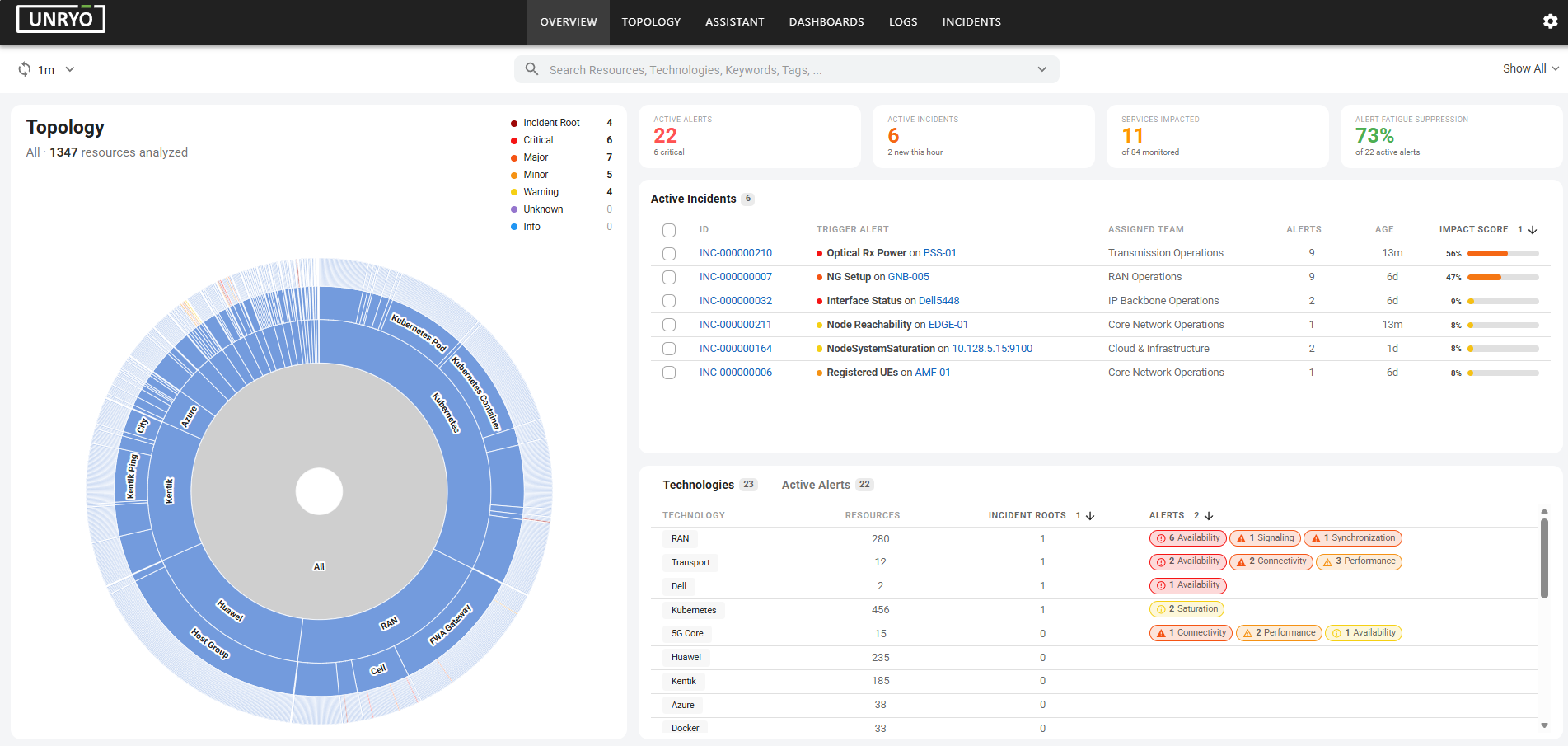

Alarms in, diagnosed incidents out, AI agents governable. All through open standards.
MONTREAL, QC, CANADA, September 15, 2026 /EINPresswire.com/ — Unryo, a provider of agentic AI software for network operators, already correlates alarms from an operator’s whole multi-vendor stack into a few diagnosed, root-cause incidents, the kind of data a one-off integration has typically had to translate between systems. Unryo has now implemented the industry-standard TM Forum Open APIs: Alarms flow in, diagnosed incidents flow out, and Unryo’s agentic AI can be governed, all through open standards, not custom integrations.
As operators adopt agentic AI, standard interfaces are how AI agents consume network data and how those agents get governed. Unryo is building that path on TM Forum standards.
Three Interfaces
– TMF642 Alarm Management (v5.0), inbound.
Any system that emits TMF642 alarms can send them to Unryo. Unryo normalizes and correlates them with every other source, feeding its AI agents. Telecom assurance tools speak this standard: ServiceNow’s Alarm Management module (built on TMF642 v5.0.0) and platforms like Ciena Blue Planet are examples. Onboarding a TMF source becomes configuration, not a new connector.
– TMF724 Incident Management (v4.0), outbound.
Unryo exposes its diagnosed incidents: root cause, correlated alarms, fault object, affected resources. A consuming system, or an AI agent, gets the finished incident, not a raw alert stream to re-interpret. TMF724 is built for network incidents with root cause, exactly what Unryo’s AI produces.
– TMF915 AI Management (v4.0), outbound: the AI itself becomes inspectable.
Unryo exposes its AI agents as governable model records. An external system can query what AI Unryo runs, its version and characteristics, including that its correlation is deterministic and carries per-decision reasoning, and inventory it alongside other models. This is how agentic AI becomes auditable.
Both directions, one standard
TMF-capable sources send alarms in (TMF642). OSS, ITSM systems, and AI agents pull diagnosed incidents out (TMF724). No connector per tool. This is the Manager-of-Managers shape: many sources in, one correlated view out.
Systems like ServiceNow can consume Unryo’s incidents this way. So can any TMF-conformant system, or autonomous agent. The benefit is not tied to one vendor.
Same incident, everywhere
The TMF interfaces expose the same data Unryo uses internally, not a reduced copy. The NOC, downstream systems, and AI agents see one consistent view of a fault, not conflicting pictures.
Governable agentic AI
Agentic AI in the network raises a real question for operators: how do you govern autonomous AI making operational decisions? Unryo answers it with TMF915. Its AI is inventoried over the standard, and because its correlation is deterministic and explainable rather than a black box, its records fit the transparency and oversight expectations of regulation like the EU AI Act. Unryo supports this; compliance stays the operator’s responsibility.
About Unryo
Unryo is a full-stack observability and agentic AI platform for network operators. Its Topology Data Fabric discovers and maps multi-layer dependencies across physical, logical, and application infrastructure, giving AI agents the context to find root cause and drive resolution. Available on-premise, cloud, and hybrid.
Virginie Porter
Unryo Inc.
info@unryo.com
Visit us on social media:
LinkedIn
Legal Disclaimer:
EIN Presswire provides this news content “as is” without warranty of any kind. We do not accept any responsibility or liability
for the accuracy, content, images, videos, licenses, completeness, legality, or reliability of the information contained in this
article. If you have any complaints or copyright issues related to this article, kindly contact the author above.

Media gallery