Deck and Patio TuneUp Updates Material Guidance for Humid Conditions
WILMINGTON, NC - September 02, 2026 - PRESSADVANTAGE - Deck and Patio TuneUp has updated the guidance it provides to
Press Release Disclaimer: This is a press release distributed through the XPR Media network. It has not been independently verified by our newsroom.

WILMINGTON, NC – September 02, 2026 – PRESSADVANTAGE –
Deck and Patio TuneUp has updated the guidance it provides to property owners on decking material selection, citing NOAA’s August 6, 2026 hurricane season outlook revision and the extended humid period it implies for the southeastern North Carolina coast. The licensed North Carolina general contractor says exposure duration, rather than rainfall volume, is the condition that most often separates materials that perform locally from those that do not.
NOAA raised the probability of a below-normal Atlantic hurricane season from 55 percent to 75 percent in its August update, attributing the revision to a very strong El Niño pattern expected to persist through the fall. NOAA’s Climate Prediction Center places the probability of that pattern continuing through the December 2026 to February 2027 period at 96 percent, and El Niño is historically associated with wetter cool-season conditions across the Southeast. NOAA states that the outlook is a general guide to overall seasonal activity and is not a landfall forecast.
For outdoor structures, the practical consequence is a longer period of elevated moisture rather than a shorter period of severe weather. That distinction matters at the point of material selection, because materials respond differently to sustained exposure than they do to intermittent exposure.
The underlying mechanism is documented in published technical literature. The USDA Forest Products Laboratory reports that wood decay fungi become active once wood moisture content remains sustained above a threshold level, which means the duration of wetting governs deterioration more than the quantity of water involved. A surface that dries fully between wetting events behaves differently from one that does not, even when both receive identical rainfall.
The American Wood Protection Association use category system reflects the same principle in how it classifies exposure. Above-ground applications and ground-contact applications are specified separately, with different preservative retention levels required for each, because the two positions differ in how long a member stays wet and how readily it dries afterward.
“The material that suits a property is decided by the conditions at that property, not by what looks right in a sample,” said Mark Pacheco, Co-Owner of Deck and Patio TuneUp. “Two houses on the same street can present different exposures, and that changes the specification.”
Site conditions vary considerably across the region. The Natural Resources Conservation Service publishes drainage classifications for individual soil series through its Web Soil Survey, and soils across southeastern North Carolina range from excessively drained sands to poorly drained flats, sometimes within a single subdivision. Drainage class affects how long the ground beneath a structure holds water after rainfall, which in turn affects the moisture environment surrounding the framing above it.
Elevation, airflow and sun exposure produce further variation within a single property. A section of deck with restricted air movement beneath it holds moisture longer than an exposed section receiving the same rainfall, and a shaded portion of a structure dries more slowly than a portion in direct sun. Those differences occur across distances measured in feet rather than miles.
Material categories differ in composition, and those differences determine how each responds to moisture. Pressure-treated lumber and dense tropical hardwoods are both wood but differ in density and grain structure. Composite decking combines wood fiber with polymer. PVC decking contains no wood content. The performance characteristics of any specific product are documented in that manufacturer’s published technical data and, where applicable, in evaluation reports issued by ICC Evaluation Service, which assesses products against defined criteria including moisture behavior.
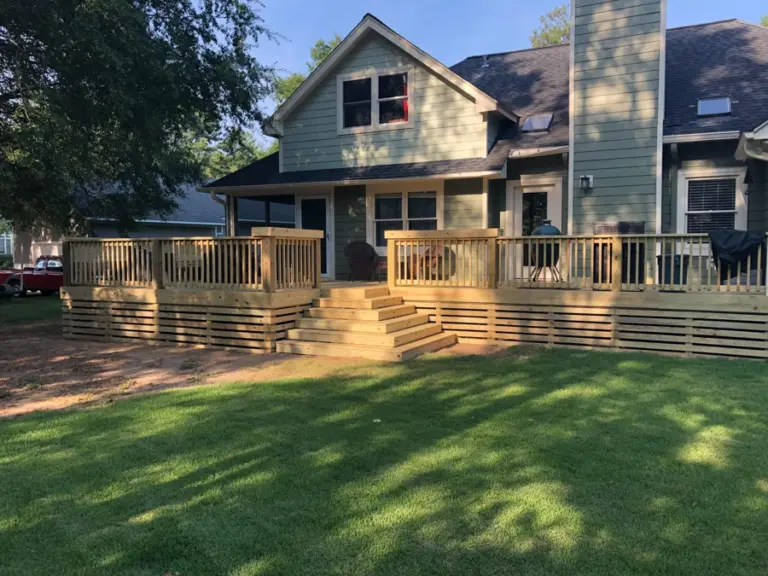
Deck and Patio TuneUp install composite, PVC, pressure-treated wood and hardwood decking, and select among them according to the exposure conditions present at each site rather than applying a single default specification across every project.
The same reasoning applies below the walking surface, where conditions differ from those above it. Ground-level areas beneath a deck experience slower air movement and later drying than the exposed surface, and framing occupies that zone continuously rather than seasonally. Under decking systems channel water away from the framing beneath an elevated deck, reducing the duration of moisture contact on the structural members below while creating dry usable space at ground level.
Deck and Patio TuneUp evaluates existing structures through its deck repair and assessment work, distinguishing surface weathering from structural change rather than treating the two as a single condition. A structure can show substantial surface wear while remaining sound, or present an acceptable surface while its supporting members have begun to deteriorate. Separating those two conditions determines the scope of any work that follows.
Deck and Patio TuneUp is a licensed North Carolina general contractor that designs and builds custom decks, porches, pergolas and outdoor living structures for residential and commercial properties throughout southeastern North Carolina. The company was founded in 2013 and provides 3D design, permit acquisition and dedicated project management across the projects it builds.
###
For more information about Deck and Patio TuneUp, contact the company here:
Deck and Patio TuneUp – Hampstead
Mark Pacheco
+19106657511
markapacheco@gmail.com
311 Judges Rd #1c, Wilmington, NC 28405, United States