
Building Management System Market Report Examines Market Dynamics, Segment Insights And Company Strategies
The Business Research Company’s Building Management System Global Market Report 2026 – Market Size, Trends, And
Press Release Disclaimer: This is a press release distributed through the XPR Media network. It has not been independently verified by our newsroom.
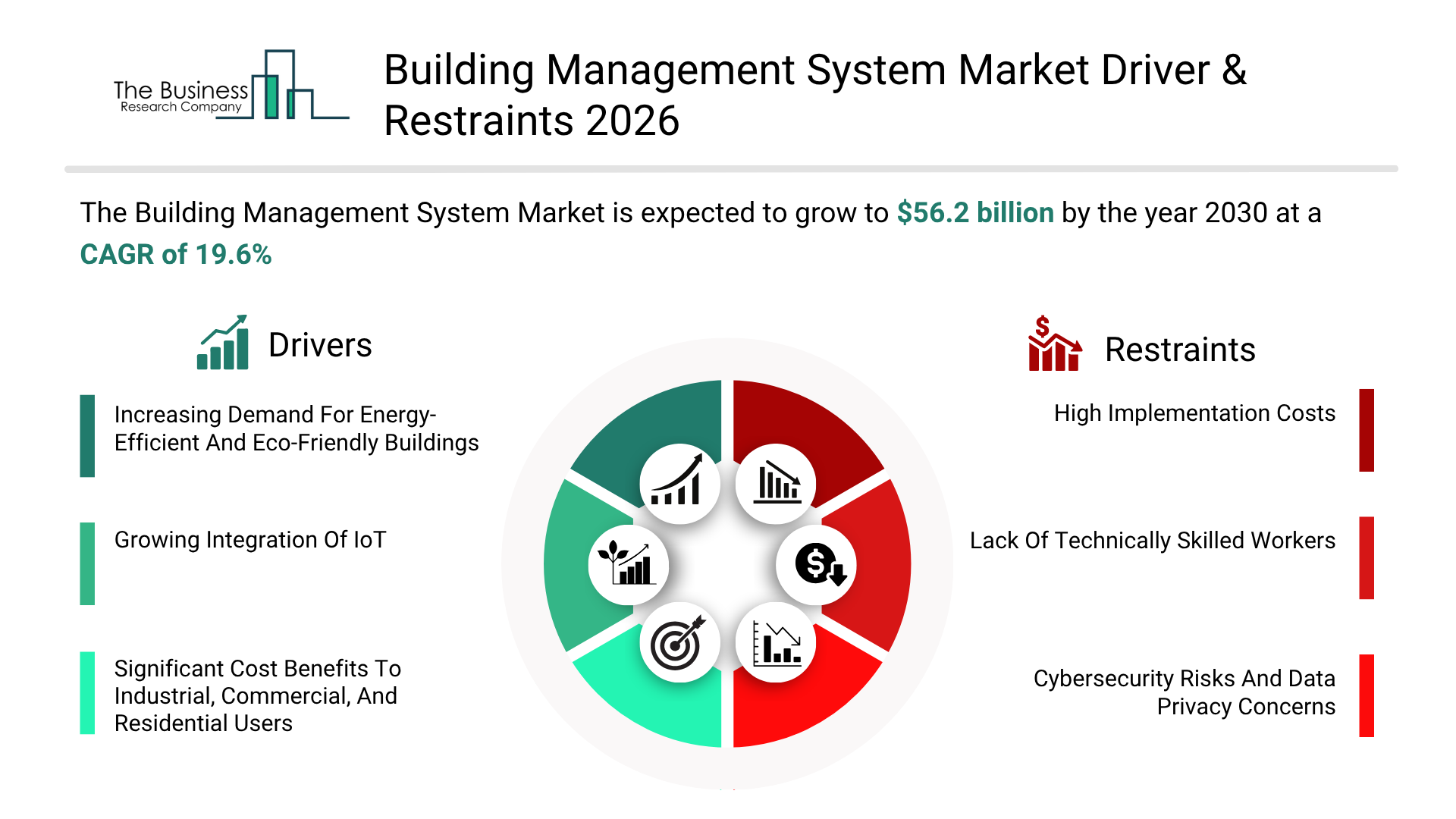

The Business Research Company’s Building Management System Global Market Report 2026 – Market Size, Trends, And Forecast 2026-2035
LONDON, GREATER LONDON, UNITED KINGDOM, October 27, 2026 /EINPresswire.com/ — The building management system sector is experiencing rapid evolution as smart technologies reshape how buildings operate and conserve energy. This market, nestled within the larger smart technology ecosystem, is becoming increasingly vital for enhancing operational efficiency and sustainability in commercial, residential, and industrial environments. Let’s explore the current market scenario, key growth drivers, major players, and emerging trends shaping this dynamic industry.
Building Management System Market Value Set to Surpass $56 Billion by 2030
The building management system (BMS) market is on track to exceed $56 billion by 2030. It forms a niche within the expansive smart technology sector, which is projected to reach nearly $3,634 billion by the same year, with BMS representing roughly 2% of this total. Within the broader Information Technology industry forecasted at $13,788 billion by 2030, building management systems account for close to 0.4%. The market is expanding at a healthy compound annual growth rate (CAGR) of 20% through 2030, driven by rising demands for automation and energy efficiency.
Request A Free Sample Of The Building Management System Market Report
https://thebusinessresearchcompany.com/sample_request?id=25601156&type=smp&name=Building%20Management%20System%20Market%20Report%202026&utm_source=EINPresswire&utm_medium=Paid&utm_campaign=Oct_PR
Software Dominates the Building Management System Market Share
Among the key components—hardware, software, and services—software is expected to take the lead by 2030, making up 55% of the market or about $31 billion in value. This growth is fueled by advancements in cloud-native platforms, the need for centralized control of multiple sites, innovations in digital twins and building analytics, as well as occupancy intelligence and space utilization technologies. Open-protocol platforms enabling interoperability and automated fault detection are also significant contributors, helping to improve efficiency and reduce lifecycle costs.
Building Management System Market Segmentation by Technology and End-User
The market categorizes technology into wireless and wired systems, accommodating different infrastructure needs. End-users span a broad range of sectors, including commercial, residential, industrial, and government or public buildings, reflecting the widespread adoption of BMS solutions across building types.
Access The Detailed Building Management System Market Report Here
https://thebusinessresearchcompany.com/report/building-management-system-global-market-report?utm_source=EINPresswire&utm_medium=Paid&utm_campaign=Oct_PR
Primary Factors Accelerating Growth in the Building Management System Market
A key growth engine for the BMS market is the increasing demand for energy-efficient and environmentally friendly buildings. Organizations aim to reduce energy consumption and operating expenses by using BMS platforms to monitor HVAC, lighting, and other systems in real time, optimizing energy use. These systems assist building owners in obtaining green certifications, meeting environmental goals, and minimizing emissions without compromising occupant comfort. Regulatory support for sustainable construction also fuels this trend, which is expected to provide an annual growth contribution of 2.7%.
The integration of Internet of Things (IoT) technology is another vital driver. Connected sensors and devices continuously gather data on temperature, occupancy, lighting, and equipment performance, enabling BMS platforms to automate functions, quickly identify problems, reduce energy waste, and facilitate remote monitoring. This IoT adoption is forecasted to add roughly 2.3% yearly growth to the market.
Cost savings across industrial, commercial, and residential sectors further boost market expansion. Automated controls help lower utility bills by optimizing energy use and reducing idle equipment operation. Predictive maintenance capabilities prevent costly equipment failures and minimize downtime, extending asset lifespans. These financial advantages encourage broader acceptance of BMS technology and contribute about 2.0% annual growth to the market.
Regional Market Leaders and Growth Hotspots for Building Management Systems
North America is positioned as the largest regional market for building management systems by 2030, expected to reach $19 billion, growing from $8 billion in 2025 at an 18% CAGR. This growth is driven by modernization efforts in commercial and institutional buildings, stringent energy efficiency standards, widespread adoption of smart HVAC and lighting systems, retrofitting aging infrastructure, and investments in smart real estate and data centers across the United States and Canada.
The United States stands out as the dominant country with projected market revenue hitting $17 billion by 2030, up from $7 billion in 2025 at the same growth rate. This surge is supported by initiatives promoting net-zero emissions and sustainable buildings, growing use of intelligent automation in healthcare, education, and commercial sectors, demand for real-time performance optimization, sensor-driven predictive maintenance, and continuous upgrades to enhance occupant comfort and building resilience.
Top Companies Steering the Building Management System Market
Schneider Electric SE leads the global market, holding a 13% share of sales in 2025. Its building automation division offers a wide range of solutions, including building management platforms, energy management, HVAC and lighting controls, security systems, and digital services tailored for commercial, industrial, and institutional clients.
Other prominent players in the market include Johnson Controls International plc, Siemens AG, Honeywell International Inc., ABB Group, Carrier Global Corporation, Trane Technologies plc, Mitsubishi Electric Corporation, Legrand SA, and Emerson Electric Co., among others.
Market Concentration and High Entry Barriers in the Building Management System Industry
The BMS market is highly concentrated, with the top 10 companies accounting for 45% of total revenue in 2025. This concentration results from significant barriers to entry, such as complex automation requirements, stringent energy efficiency regulations, advanced software needs, and the demand for reliable, interoperable, and scalable solutions. These leading firms maintain strong positions through extensive product portfolios, strategic partnerships, global distribution networks, and ongoing innovation in building automation and energy management. As demand grows for integrated security, cloud-based monitoring, and intelligent operations, these companies are expected to deepen their market foothold through collaboration, product development, and geographic expansion.
Competitive Strategies Shaping Market Leadership in Building Management Systems
Key competitive tactics revolve around advancing smart building technologies to enhance performance and efficiency. Companies are leveraging the Internet of Things and cloud platforms to strengthen real-time building monitoring capabilities. Expanding intelligent infrastructure to support sustainable and resilient operations is a priority, alongside integrating artificial intelligence to improve maintenance processes and optimize energy consumption.
The Role of Automation in Driving Building Management System Innovation
Automated building management solutions are revolutionizing the market by streamlining operations, boosting energy efficiency, and improving occupant comfort. For example, Honeywell International Inc. introduced in January 2024 its Advance Control for Buildings platform. This solution harnesses automation, machine learning, and cybersecurity to enhance operational efficiency, tighten system security, and enable smarter, more energy-conscious building management.
Software Segment Offers the Largest Market Opportunity by 2030
Together, hardware, software, and services segments are expected to contribute over $33 billion to the building management system market’s value by 2030. Software leads this growth with a $23 billion increase anticipated between 2025 and 2030, driven by demand for edge-enabled controllers, smart sensors, integrated lifecycle support, digital twin platforms for asset management, occupancy-based automation, indoor environmental quality monitoring, interoperable communication protocols, and investments in facility modernization. These developments underscore the industry’s focus on connected, adaptable, energy-efficient buildings that emphasize operational resilience and data-driven management.
Key Supply Chain Participants in the Building Management System Market
Major raw material suppliers include industry leaders such as Siemens AG, Schneider Electric SE, ABB Ltd., Mitsubishi Electric Corporation, Omron Corporation, Delta Electronics Inc., and Bosch Rexroth AG. Other important suppliers are Belden Inc., CommScope Holding Company Inc., Panduit Corporation, Legrand SA, Eaton Corporation plc, Hubbell Incorporated, Rockwell Automation Inc., and Phoenix Contact GmbH & Co. KG.
Leading wholesalers and distributors consist of companies like WESCO International Inc., Sonepar Group, Rexel S.A., Graybar Electric Company Inc., Anixter International Inc., Crescent Electric Supply Company, Border States Electric Supply, City Electric Supply Holdings Limited, and several regional distributors.
Among major end users are Johnson Controls International plc, Honeywell International Inc., Carrier Global Corporation, Trane Technologies plc, Cisco Systems Inc., IBM Corporation, Oracle Corporation, Microsoft Corporation, SAP SE, Hitachi Ltd., Fujitsu Limited, NEC Corporation, Huawei Technologies Co. Ltd., Dell Technologies Inc., Hewlett Packard Enterprise Company, BuildingIQ Inc., Distech Controls Inc., Automated Logic Corporation, Delta Controls Inc., Computrols Inc., KMC Controls Inc., Reliable Controls Corporation, Alerton Inc., and Crestron Electronics Inc.
Key enhancements in our 2026 market reports include:
• Market attractiveness scoring and analysis
• Total addressable market (TAM) analysis
• Company scoring matrix graphics and tables
• Excel-based forecasting dashboards
• Market hotspots infographics
• Key technologies and future trend analysis
• Updated graphics and tables
Learn More About The Business Research Company
The Business Research Company (www.thebusinessresearchcompany.com) is a leading market intelligence firm renowned for its expertise in company, market, and consumer research. We have published over 30,000+ reports across 27 industries and 60+ geographies. Our research is powered by 1,500,000 datasets, extensive secondary research, and exclusive insights from interviews with industry leaders.
We provide continuous and custom research services, offering a range of specialized packages tailored to your needs, including Market Entry Research Package, Competitor Tracking Package, Supplier & Distributor Package and much more.
Disclaimer: Please note that the findings, conclusions and recommendations that TBRC Business Research Pvt Ltd delivers are based on information gathered in good faith from both primary and secondary sources, whose accuracy we are not always in a position to guarantee. As such TBRC Business Research Pvt Ltd can accept no liability whatever for actions taken based on any information that may subsequently prove to be incorrect. Analysis and findings included in TBRC reports and presentations are our estimates, opinions and are not intended as statements of fact or investment guidance.
Contact Us:
The Business Research Company
Americas +1 310-496-7795
Europe +44 7882 955267
Asia & Others +44 7882 955267 & +91 8897263534
Email: marketing@tbrc.info
Follow Us On:
LinkedIn: https://in.linkedin.com/company/the-business-research-company
Oliver Guirdham
The Business Research Company
+44 7882 955267
info@tbrc.info
Visit us on social media:
LinkedIn
Facebook
X
Legal Disclaimer:
EIN Presswire provides this news content “as is” without warranty of any kind. We do not accept any responsibility or liability
for the accuracy, content, images, videos, licenses, completeness, legality, or reliability of the information contained in this
article. If you have any complaints or copyright issues related to this article, kindly contact the author above.

Media gallery

