
Vadzo Imaging Positions Innova-521CRS: Onsemi AR0521 5MP Color Rolling Shutter GigE Camera for Continuous Day and Night Video Monitoring
The Innova-521CRS is a 5MP Color Rolling Shutter GigE Camera built on the Onsemi AR0521 sensor, and Vadzo is
Press Release Disclaimer: This is a press release distributed through the XPR Media network. It has not been independently verified by our newsroom.


The Innova-521CRS is a 5MP Color Rolling Shutter GigE Camera built on the Onsemi AR0521 sensor, and Vadzo is positioning it for continuous day and night video monitoring. Monitoring sites ask a camera to cover a wide area, to see in dim light, to cope with headlights and bright windows, and to keep working for months. A 5MP frame covers more ground than a 2MP frame, large 2.2 micron pixels gather light after dark, and HDR keeps bright and dark regions readable in the same picture. As a 5MP Ethernet Camera and an AR0521 Color Ethernet Camera, the Innova-521CRS connects over a single network cable, complies with ONVIF so standard video software can use it, supports PTP synchronization so several units share a time base, and finishes the picture in an onboard ISP. For monitoring that needs sharp stills of moving subjects, the sensor can also work with an external mechanical shutter. Designed for integrators building around-the-clock monitoring, it brings coverage, sensitivity, and standards support together.
FORT WORTH, TX / ACCESS Newswire / October 21, 2026 / Vadzo Imaging, a provider of embedded vision camera products for OEMs and system integrators, today positions the Innova-521CRS as a 5MP Color Rolling Shutter GigE Camera for continuous day and night video monitoring. Built on the Onsemi AR0521 sensor and part of Vadzo’s GigE camera portfolio, the Innova-521CRS combines 5MP resolution, superior low-light performance, HDR, ONVIF compliance, PTP synchronization, an on-board ISP, and external mechanical shutter support in one module. With this positioning, Vadzo presents a 5MP ONVIF GigE Camera for perimeter, parking, entrance, and wide-area monitoring, together with guidance on how a rolling shutter sensor behaves in monitoring scenes and how to use its HDR and mechanical shutter options well.
Why a 5MP Color Rolling Shutter GigE Camera Requires Resolution and Low-Light Sensitivity for Video Monitoring
Monitoring is a demanding use for a camera because the conditions never stay the same. A yard is bright at noon, dark at midnight, and lit by moving headlights at dusk. A lobby has a glass door that turns into a mirror at night and a glare source at sunrise. A parking lot has to be watched in the rain. In every case, the camera must deliver a picture that a person or an analytics program can use, hour after hour, and the failure modes are specific. Dark scenes fill with noise, bright sources wash out nearby detail, and fast subjects look different from one frame to the next. Each of these problems is common, and a camera that handles one well can fail at another.
Coverage adds a trade-off. A wider view means fewer camera units and lower installation cost, but it also means that people and vehicles occupy fewer pixels. A 2MP camera watching a wide yard may leave a face or a plate too small to read. More resolution fixes that, but small pixels collect less light, so a sensor that chases pixel count can pay for it at night. The designer needs a sensor with enough pixels for coverage and pixels large enough to see in the dark, and that balance is not common. A sensor chosen with both needs in mind saves the integrator from a difficult trade-off later.
Shutter behavior is a third issue that monitoring teams often overlook. Most sensors at this resolution read the image row by row, which suits scenes that move slowly and gives good sensitivity at reasonable cost. A fast vehicle or a person running across the frame can look skewed. For video, the effect is usually acceptable. For a still image used as evidence, it can be a problem. A mechanical shutter that closes the optical path during sensor readout removes the skew from a still, but only if the camera and the sensor are designed to work with one. Many teams therefore ask early whether the module supports the option.
Integration closes the list. Monitoring systems with many camera positions need units that appear in standard video software without custom work, and they need timestamps that agree between camera units so reviewers can follow a subject from view to view. A camera that lacks these features moves work onto the integrator, and the cost appears at commissioning, when the hardware is already installed. Choosing a module with standards support from the start avoids that late work.
Innova-521CRS: 5MP Color Rolling Shutter GigE Camera Performance in Day and Night Conditions
The Innova-521CRS is built on the Onsemi AR0521, a 5MP (2592 x 1944) color rolling shutter sensor with a 1/2.5 inch optical format and 2.2 micron pixels. The pixel size is the first lever for low-light performance, because a larger pixel collects more photons in each exposure. The sensor uses a back-illuminated pixel structure that improves light collection further. The result is an AR0521 GigE Camera that starts with a stronger signal after dark, which is the most effective way to improve a night image before any processing. A 5MP frame on 2.2 micron pixels is also a deliberate balance, since far more pixels of the same size would need a larger and costlier sensor.
HDR is the second lever. The sensor supports line-interleaved HDR, in which rows with long and short exposures are interleaved within a single frame and combined, and the dynamic range can exceed 96dB. A scene with headlights, a lit sign, and a dark lot can then show detail in each region without the ghosting that sequential multi-frame HDR can cause on moving subjects. Because some rows serve each exposure, a little vertical detail is traded for range, and teams should test the mode on their own scenes, ideally with the same bright sources and dark areas that the finished site will contain. The on-board ISP then finishes the image inside the module, handling color processing, noise reduction, auto exposure, and auto white balance, so the network receives a processed picture. Teams that want a different balance of noise reduction and sharpness can adjust the available controls.
For network integration, the module complies with ONVIF, which lets standard video management and recording software discover the camera and use its video without custom code. It also supports PTP synchronization, which follows the Precision Time Protocol defined in IEEE 1588. PTP aligns the camera clock to a network time source so that frames from several units carry a common time base, and reviewers can follow a subject across views. PTP depends on a network that supports it, and Vadzo recommends testing the alignment on the real switches before a large rollout. A small pilot network is usually enough to reveal any issue before it affects many sites.
The sensor also supports control of an external mechanical shutter. A mechanical shutter closes the optical path while the rows are read, so every row sees the same moment, and a still image of a fast-moving subject loses the skew that a rolling shutter would add. This is a choice for stills and snapshots, not for continuous video, and it requires an external shutter assembly and the signals to drive it. Teams should confirm the available control signals and timing with Vadzo before designing the mechanics. Early discussion also helps decide where the shutter sits in the optical path and how the enclosure holds it.
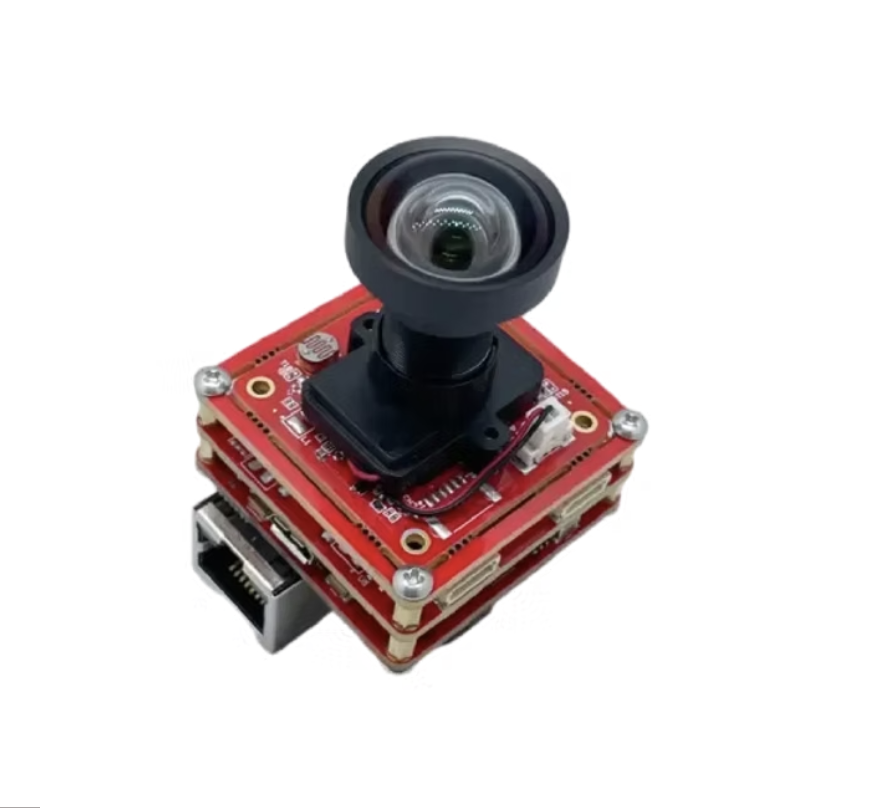
Product Overview
The Innova-521CRS is a 5MP color GigE module built on the Onsemi AR0521 sensor and positioned for continuous day and night video monitoring. As a 5MP Gigabit Ethernet Camera, it is built for integrators who want wide coverage and low-light sensitivity from one network-connected unit. The module combines the sensor, an on-board ISP, and a standard network interface, with ONVIF compliance and PTP synchronization. As an AR0521 GigE Camera, it delivers 5MP color video with the sensor’s HDR and low-light strengths, and the 5MP PTP Synchronization GigE Camera designation reflects its time alignment for multi-camera sites. As a 5MP On-board ISP GigE Camera, it finishes the image inside the module. The module also serves as an AR0521 Gigabit Ethernet Camera for designs that need a standard network interface.
Key specs: 5MP (2592 x 1944) Max Resolution | Onsemi AR0521 1/2.5 inch Sensor Format | 2.2 micron Pixel | Color with Rolling Shutter | GigE Interface | S-Mount (M12) Optics
Key Capabilities of the Onsemi AR0521 5MP Color Rolling Shutter GigE Camera
5MP ONVIF Ethernet Camera Compliance for Standard Video Management Software
ONVIF is an industry standard that lets network video products from different makers work together. The Innova-521CRS AR0521 5MP ONVIF Ethernet Camera can be discovered by standard video management and recording software, which then requests its video without custom code. This shortens commissioning in large sites, where installers expect a camera to appear in their software with little effort. Teams should confirm the specific ONVIF features and profiles they need against the module documentation. Operators who manage many sites also gain from one discovery method across all their camera units.
5MP PTP Synchronization for Multi-Camera Monitoring
When several camera units cover the same area, reviewers need recordings that line up in time. PTP synchronizes each camera clock to a network time source, so frames carry a common time base. As a 5MP PTP Sync Ethernet Camera and an AR0521 PTP GigE Camera, the module lets reviewers follow a person or vehicle from one view to the next and lets analytics combine views accurately. PTP needs a network that supports it, and a short pilot on the actual switches is the best way to confirm the result. Testing with the real network load gives the most honest answer.
On-Board ISP for Day and Night Image Processing
The on-board ISP finishes the picture inside the module and applies automatic functions that matter in monitoring. Auto exposure follows the light as dusk falls, and a region-of-interest approach to metering helps when a bright sign or window occupies part of the frame, which is how a 5MP ROI Auto Exposure Camera keeps the important area correctly exposed. Auto white balance keeps colors steady as lighting shifts, so a 5MP AWB GigE Camera describes vehicles and clothing consistently from afternoon to night, and an operator searching footage for a red vehicle finds it whether the clip was recorded at noon or after dark. Every unit delivers the same processing, which keeps a multi-camera site looking uniform. Reviewers then compare footage from different positions without adjusting for differences in color or brightness.
Superior Low Light Performance for a Day-Night Monitoring GigE Camera
Night footage depends on how much light the sensor can collect. The 2.2-micron back-illuminated pixels give the module a strong starting signal in dim scenes, which means less gain is needed to reach a usable brightness and less noise is amplified along with the picture. Teams should still plan supplementary lighting where the scene is very dark, because no sensor creates light that never arrives, and a modest lamp placed well often improves a night image more than any change to the camera settings. Evaluating the module at the real site, at the real hour, is the surest way to judge the result. Recording a full evening, from late afternoon to well after dark, shows how the camera behaves across the whole range.
HDR Imaging for High-Contrast Monitoring Scenes
Monitoring scenes mix bright and dark regions all the time. As a Continuous Video Monitoring Camera, the Innova-521CRS uses line-interleaved HDR to keep both ends readable in one frame, which helps with headlights at night, sun on a doorway, and lit signs against dark walls. Because the mode trades a little vertical detail for range, teams should record the same scene with HDR on and off and decide which suits the application. A short comparison usually settles the question in a day.
External Mechanical Shutter Support for Distortion-Free Stills
The sensor can work with an external mechanical shutter, which closes the optical path during row readout so a still image of a fast subject shows no skew. This is useful where a snapshot serves as evidence, such as a vehicle at a gate. It is a choice for stills, and continuous video continues to use the rolling shutter. The option needs an external shutter assembly and drive signals, and Vadzo can advise on the available control and timing. Teams that plan stills as evidence should discuss timestamps and metadata early, and PTP can help here, since a shared time base makes it simpler to match a still to the video around it.
AR0521 Gigabit Ethernet Camera Integration as a 5MP GigE Camera Manufacturer Offering
The Innova-521CRS connects over a standard network interface and fits switched infrastructure that many sites already own. As a 5MP GigE Camera Manufacturer, Vadzo supports lens matching, firmware customization, and enclosure design, and its record across several sensor families and interface types lets teams move from evaluation to volume with the same module and documentation. The module also serves as a 5MP Ethernet Camera in designs that need a color unit with standard connectivity. Teams moving from a pilot to a larger rollout keep the same module and documentation throughout.
“Monitoring teams are always balancing coverage against sensitivity. A wider view saves camera units, but small pixels struggle after dark. The Innova-521CRS was positioned to ease that trade-off. The 5MP frame covers more ground, the 2.2 micron pixels keep night footage usable, and the HDR mode keeps headlights and bright doorways from washing out the scene. ONVIF and PTP then make it easy to deploy and to review. We are also candid about the shutter. It is a rolling shutter, which suits video well, and for stills of fast subjects we support an external mechanical shutter. We encourage customers to test on their own site at night, with the lens, mounting height, and lighting they plan to use, because those details change the result more than any single specification.” – Alwin Vincent, Product Manager, Vadzo Imaging.
Application Specific Sections: Round the Clock Monitoring in Practice
Continuous Video Monitoring Camera for Perimeters and Yards
Perimeters and yards are large, dark at night, and lit by passing headlights. The Innova-521CRS works as a Continuous Video Monitoring Camera whose 5MP frame covers a wide area and whose HDR mode handles headlights against a dark background. Fewer units can cover the same ground than with 2MP camera units, which lowers cabling and mounting costs. Teams should plan supplementary lighting for the darkest zones and test the mode at the real site. Operators can review the footage afterward by zooming into the region where an event occurred.
Day Night Monitoring GigE Camera for Parking and Access Points
Parking lots and gates need clear images of vehicles in all light. The module serves as a Day Night Monitoring GigE Camera that keeps vehicles readable from afternoon through night, and with an external mechanical shutter, it can produce distortion-free stills of passing vehicles for records. Auto white balance keeps vehicle colors consistent, and ONVIF compliance lets operators use their existing recording software. Gate and lot operators also benefit from consistent exposure as the light changes through the day.
Continuous Day Night Monitoring Camera for Lobbies and Entrances
Lobbies and entrances combine glass doors, bright windows, and interior lighting. The camera functions as a Continuous Day Night Monitoring Camera whose HDR mode keeps people readable against a bright doorway by day and against reflections at night. PTP synchronization lets several units covering one entrance align their recordings for review. Glass doors that reflect at night are a common challenge, and a test at the real site determines how the picture looks.
Around-the-Clock Monitoring Camera for Wide Areas and Corridors
Wide areas such as plazas, loading yards, and long corridors reward resolution. The module works as an Around the Clock Monitoring Camera whose 5MP detail lets operators digitally zoom into a region after the event, and whose low-light sensitivity supports night review. Teams that need to read very small details at long range should check pixel density for their lens and distance. Wide areas are often covered by a mix of units, with the 5MP module serving the positions where coverage matters most.
Frequently Asked Questions
Q: Why choose a 5MP camera instead of a 2MP camera for monitoring?
A: A 5MP frame covers a wider area at the same detail, or shows more detail at the same coverage, so fewer units can watch the same ground, and operators can zoom into a region after an event. Vadzo Imaging designs its 5MP Ethernet Camera around that benefit while keeping pixels large enough to see after dark. The trade-offs are higher data rates and storage needs, so Vadzo Imaging recommends checking the network and recorder capacity before choosing, and testing one unit on the real site before ordering many. An Around the Clock Monitoring Camera should be judged at night as well as by day, so a short trial that covers both is worthwhile.
Q: What is a rolling shutter, and when does it matter for monitoring?
A: A rolling shutter reads the image row by row, which gives high resolution and good sensitivity at reasonable cost. For slow or still subjects, it makes no visible difference. A fast-moving vehicle or a running person can look slightly skewed. Vadzo Imaging suggests that most monitoring video is fine with a rolling shutter, and for sharp stills of fast subjects it offers an external mechanical shutter option, and global shutter models in its portfolio for scenes where continuous fast motion is the main concern. A Day Night Monitoring GigE Camera is most useful when the shutter, the lighting, and the recording plan are chosen together.
Q: What is an external mechanical shutter, and why use one with a rolling shutter sensor?
A: A mechanical shutter is a physical blade that closes the optical path while the sensor reads its rows. Every row then sees the same moment, so a still image of a fast subject shows no skew. It suits snapshots used as evidence, such as a vehicle at a gate, and it is not used for continuous video. It requires an external shutter assembly and drive signals, and Vadzo Imaging can advise on the control and timing, which helps teams decide whether the added hardware is worthwhile for their site. A 5MP ONVIF Ethernet Camera with this option gives integrators a way to keep video and evidence stills in the same system.
Q: How does HDR help a Continuous Video Monitoring Camera at night?
A: Night scenes contain very bright points, such as headlights and lit signs, against very dark surroundings. Without HDR, the camera exposes for one and loses the other. Line interleaved HDR combines long and short exposures within one frame, which keeps both readable, and it avoids the ghosting that sequential multi-frame HDR can cause on moving subjects. Vadzo Imaging recommends testing the mode on the real site, since it trades a little vertical detail for range, and a Continuous Video Monitoring Camera of this kind is easiest to judge by comparing footage with HDR on and off.
Q: What makes Vadzo Imaging a trusted 5MP GigE Camera Manufacturer for around-the-clock monitoring?
A: Vadzo Imaging offers more than a camera module built around a capable sensor. Integrators working with Vadzo Imaging receive a module with ONVIF compliance, PTP synchronization, an on-board ISP, and an HDR mode, along with candid guidance on the limits of a rolling shutter and of night imaging, plus engineering support for lens selection, firmware customization, and enclosure design. Vadzo Imaging maintains evaluation kits with no minimum order requirement, so teams can test on their own site before committing to volume production.
Availability
The Innova-521CRS 5MP Color Rolling Shutter GigE Camera built on the Onsemi AR0521 sensor is available now for evaluation and production orders. Evaluation kits include the camera module, S-Mount lens, and platform documentation, with no minimum order requirement, so a team can place a unit at a gate, a lobby, or a yard and watch it through a full day. Integration teams can test night image quality at their own sites, compare HDR on and off, confirm ONVIF discovery and PTP alignment on their own network, and discuss mechanical shutter options before committing to a production bill of materials, which tells them more than a datasheet comparison alone. Teams that need a different lens can ask Vadzo to review the configuration. Browse the full range of GigE camera options at Vadzo’s website or contact Vadzo at support@vadzoimaging.com to request an evaluation unit or discuss OEM integration requirements for perimeter, parking, entrance, and wide area monitoring programs.
About Vadzo Imaging
Vadzo Imaging is a global provider of embedded vision solutions and delivers high-performance camera technologies and imaging platforms for applications in robotics, industrial automation, UAVs, edge AI, and medical systems. Its products are designed for seamless integration with leading embedded platforms. Vadzo supports customers through hardware customization, firmware development, and module-level drivers, enabling faster development and deployment of vision-based systems across GigE, USB, MIPI, Wi-Fi, and SerDes camera interfaces.
Media Contact
Alwin Vincent
Vadzo Imaging
Email: alwin@vadzoimaging.com
LinkedIn: Vadzo Imaging
YouTube: Vadzo Imaging
X: Vadzo Imaging
SOURCE: Vadzo Imaging
View the original press release on ACCESS Newswire
Media gallery

